

Radiation and Particle Sensors
Our nanostructured radiation sensors are a emerging research area. These nanocomposites enable high-resolution spectroscopic detection of X-rays and gamma-rays in a low-weight and thin-film format. Aramid films are functionalized with quantum dots that reduce thermal signal losses while retaining conduction pathways for charge carriers. We also provide (a) highly-engineered crystalline silicon P-I-N detectors that excel at spectroscopic X-ray and charged-particle detection and measurement, and (b) thin-film amorphous silicon detectors for high efficiency optical sensing.
Silicon Sensors
Silicon-based PIN detectors are suitable for high-resolution charged particle detection, x-ray spectroscopy, and optical sensing.
Thin-film amorphous silicon diodes are used for photon sensing across the optical range.


Products:
-
Standard Si PIN Packages: 3 x 3 mm and 10 x 10 mm
-
Die form, pin-packaged, or packaged with SMA or BNC connectors.
-
Geometry customizable.
Spectroscopic Performance:
-
Typical x-ray and gamma-ray spectrum shown (measured from Ba-133 isotopic source).
Rad-hard Performance:
-
Negligible spectroscopic degradation to 1 kGy (Co-60).
Temperature Performance:
-
Improved noise and spectral characteristics down to 77 K.
Relevant Publications:
-
Hammig, M.D., Kang, T., Jeong, M., Suppression of Interface-Induced Noise by the Control of Electron-Phonon Interactions, IEEE TNS (2013).
-
Jeong, M., Jo, W. J., Jay, Ha, Radiation hardness characteristics of Si-PIN radiation detectors, Nuc. Inst. Meth. A (2016).
Nanosemiconductor Sensors
Semiconductor nanoparticles, also referred to as quantum dots, have the unique advantage of achieving higher-resolution than single-crystalline materials. This is attributed to the suppression of phononic modes (crystal lattice vibrations) so that more of the radiation energy is converted into an electronic signal rather than thermal noise. This also removes the need for cooling that classic materials require.
Cadmium telluride (CdTe) nanoparticles are incorporated within an aramid nanofiber (ANF) thin film. The structure retains the properties of the quantum dots while forming charge percolation pathways that provides the necessary carrier mobility.


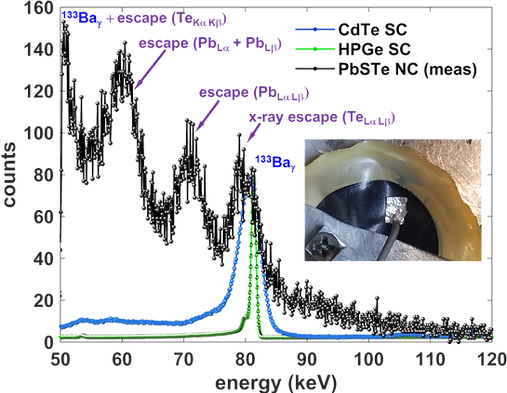
These thin film detectors are capable of room-temperature energy resolution that surpasses the single crystalline equivalent material's performance for energies up to 100 keV. At higher energies, the thin film does not provide sufficient stopping power to form clear peaks. Current development is focused on preparing thicker nanocomposite sensors.

Lead sulfide telluride (PbSxTe1-x) are an area of active research and development as a method to achieve superior stopping power of high-energy gamma-rays.
Relevant Publications:
-
Vecchio, D. A., Hammig, M. D., & Kotov, N. A. (2025). High-Resolution Radiation Sensors from Flexible Network Nanocomposites of Nanoparticles and Aramid Nanofibers. ACS nano, 19(12), 11924-11935.
-
Le, V. D., Vecchio, D. A., Uyulur, A. D., Han, I. H., Ursu, A. M., Kim, G., & Hammig, M. D. (2025). X‐ray and γ‐ray Sensing from Aqueous‐Based Lead Sulfide Telluride Nanocomposites. Small, 21(49), e04684.
-
Hammig, M. D. (2012). Nanoscale methods to enhance the detection of ionizing radiation. INTECH Open Access Publisher.